The approaches under consideration include neural interfaces and systems that change their response through feedback. This page does not establish an implementation by AgentBrain.
Research status and limits
A research direction, not a production-ready BioCore agent.
Connecting living neural systems to software is a field of research. That alone does not establish a reliable general-purpose computer. AgentBrain would first need limited experiments and reproducible comparisons.
AgentBrain is not offering a biological general-purpose computer here. Customer data and an agent's identity must not depend on such a research module.
BioCore would not be a reliable store of facts. Sources, confirmed results and permissions would need to remain stored outside the changing module.
What we would need to test
Which advantages could be measured?
We do not assume an advantage over digital AI. Each of these possible properties would need testing against a digital comparison system.
Could a module learn during operation while new states are reviewed separately first?
How much reviewed experience would be needed to improve performance?
How could changes emerging within the network be measured and bounded?
Would the entire system use less energy, including support and monitoring?
Principle
Check experience before it changes the system.
Incorrect information can affect a learning system's later behaviour. Before any adaptation, its source and permission to use it would need to be clear.
Experience
Evidence
Learning permission
New state
Approval
01
An observation is not yet a confirmed claim. The source determines what it supports.
02
Only approved experiences would be allowed to change the system.
03
Each adaptation would need to be recorded and tested. If problems occur, it would need to remain separate from ongoing operation.
Why AgentBrain
A version number does not explain every change.
Two identical systems can develop differently after different experiences. Alongside model and version, their history of changes would therefore need to be recorded.
We want to trace what changed, why it changed and who or what authorised it.
01
Which experiences shaped this state?
02
Which of them were authorized?
03
How far does the current state differ from the last validated state?
04
Which version of the system caused a concrete action?
System model
How the parts could work together.
Digital models would handle language and tools. BioCore would be considered only for narrowly defined tasks. AgentBrain and BioOS would need to check knowledge, permissions and the module's state.
AI models
General knowledge, language and tool use would remain digital.
AgentBrain
AgentBrain would retain knowledge, sources and permissions, and record the history of changes.
BioOS
BioOS would need to calibrate and monitor the module, process signals and stop operation when problems arise.
BioCore
Possible tasks include recognising patterns over time. Use would depend on a reproducible advantage over a digital comparison system.
Types of knowledge
Model knowledge, history and learned patterns.
These forms of information would serve different purposes. Confirmed facts would remain in a reviewable store, not solely within the biological module.
What does the general model know?
General knowledge and language processing.
What belongs to the earlier work?
Earlier cases, confirmed decisions and corrections, with their sources.
Which patterns has this system learned?
Patterns the module would have developed through repeated, approved experience.
Proposed learning process
New states would need to pass review.
A changed module would not immediately influence ongoing work. These review steps are proposed:
01Record experience
An event, result or feedback is recorded with its source.
02Check the basis
Source, time, scope and permissions are checked.
03Approve learning
A rules check determines whether this experience may change the module.
04Trial the adaptation
BioOS would process the approved experience in a limited learning environment.
05Compare states
The new state is compared with the last reviewed state, separately from operations.
06Check stability
Tests measure performance, stability and unexpected changes.
07Approve use
Only states that pass the agreed checks would be allowed into use.
BioCore Passport
Record how a module develops.
A BioCore record would need to show the module's origin, approved learning steps and how its state was tested.
Which physical module is this?
Which validated state does the current state descend from?
Which authorized learning events shaped it?
Which experiences may change it, and which effects may it trigger?
Is the biological substrate within its validated operating range?
Which states, policies and decisions led to an action?
Possible research path
Software and comparison tests first.
These phases are a research proposal, not a delivery schedule. Hardware would be considered only if earlier tests demonstrate value.
Phase 0Develop software to record states, learning events and approvals, including in a simulation.
Phase 1Evaluate a limited learning session against a digital comparison system.
Phase 2Define interfaces, monitoring and consistent test records.
Phase 3Consider a hardware prototype only after a reproducible advantage.
Phase 4Study integration with a digital agent under defined approvals.
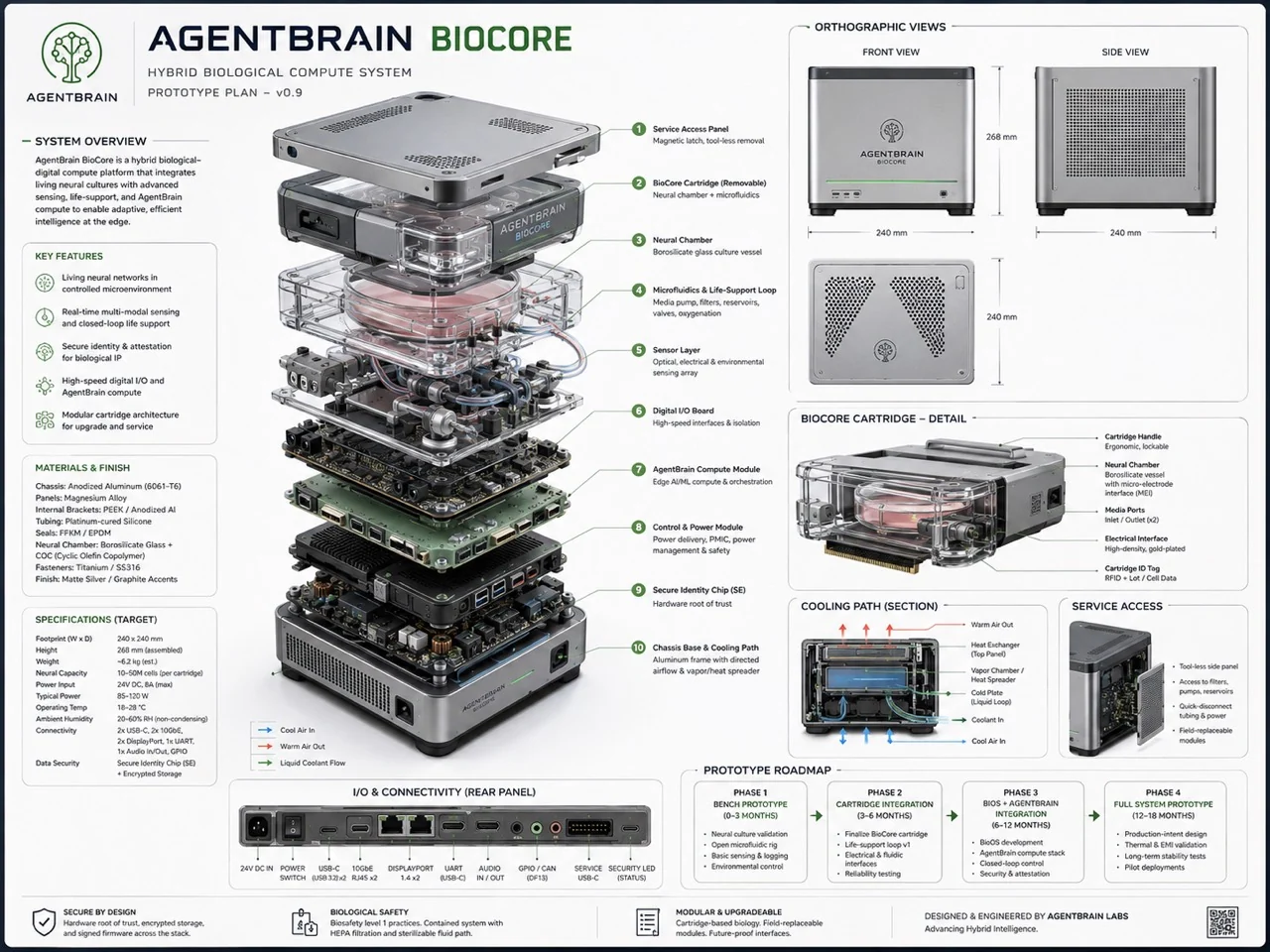
Hardware target
A closed, monitored module.
The concept proposes a replaceable module with its own controls and monitoring. Research would need to establish whether this design is practical.
Continuity through changes
The history should not depend on one module.
When a model or computing module is replaced, confirmed knowledge, permissions and earlier work should remain available.
Identity ≠ Model
Identity ≠ BioCore
Identity ≠ Session
Identity ≠ Interface
Ethics and boundaries
Limits of this research.
We make no promise of human consciousness.
This page does not provide instructions for biological experiments.
A biological signal alone must not trigger a high-risk action.
Comparisons would need to account for energy, operation and monitoring across the whole system.
If a digital system handles the task better, more safely or at lower cost, it remains digital.
Long-term vision
What would a learning system need to demonstrate?
That is the open question behind BioCore. We want to examine how experience could change a system's behaviour while preserving the sources of its knowledge and its permissions. Discussions about limited experiments and sound comparison tests are the next step.