AgentBrain Core — controlled access

Agents should not reset.Memory should not lie.Actions should not be unprovable.

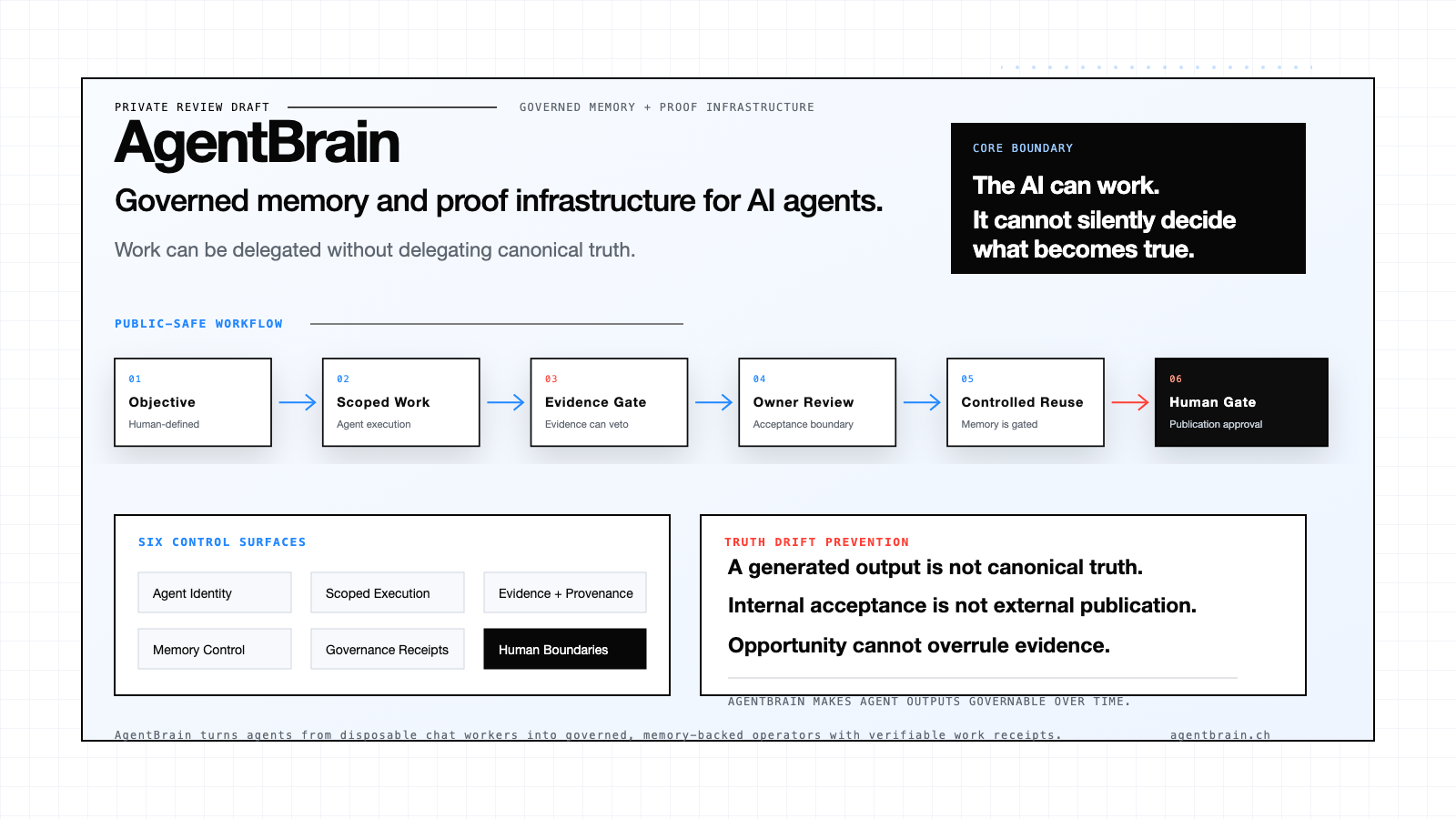
AgentBrain Core is the cognitive integrity layer for long-running AI agents — one governed brain across models, tools, sessions, agent types and runtime surfaces. Memory, identity, validity, permissions, cognitive state awareness, drift control and proof.

3 working papers on SSRN · running in production · reviewed manually · reply in 48h
AgentBrain Core
surfaces swap — the brain stays
01

The next bottleneck is not intelligence

AI agents can already reason, search, write, plan, call tools and execute workflows. But once they run over time — across tools, sessions, models and interfaces — they begin to fail in quieter ways.

This is not only a prompt problem. Not only a model problem. Not solved by a larger context window. It is a cognitive integrity problem.

02

Memory alone is not enough

A vector database can retrieve information. A long context window can hold more text. A framework can attach memory to an agent. But a long-running agent needs more than recall. It needs to know:

  1. 01what is still true,
  2. 02what has changed,
  3. 03what was corrected,
  4. 04what is uncertain,
  5. 05what is stale,
  6. 06what can be trusted,
  7. 07what requires approval,
  8. 08what it is allowed to do,
  9. 09and why it acted.
recall · validity check governed
tenant prefers email follow-upscurrent
supplier approved last quarterstale
pricing — updated by teammatecorrected
rent index assumptionuncertain
payment authority · €5k+blocked
core/validitynothing fires unchecked

AgentBrain Core adds the missing layer above memory: continuity, validity, state and proof.

03

One governed brain. Many surfaces. Many agent types.

An agent is not just a model. The surface can change, the model can change, the agent role can evolve — but identity, memory, rights, decisions, corrections, open loops and proof history need one governed place to live.

runtime surfaces

Where the agent operates.

ClaudeGPTGeminiCursorMCP toolsAPIsVoiceBrowserApps
agent types

How the agent appears.

SupportResearchFinanceOperationsLegalSalesPersonalCompany
the governed place

That place is AgentBrain Core.

IdentityMemoryRightsDecisionsProof history
04

What AgentBrain Core does

governed memory

No restart from zero.

Persistent long-term and working memory across sessions and surfaces. Decisions, corrections, goals, constraints, preferences, relationships, outcomes, open loops and working state survive the chat, the model change, the interface move. But memory is not treated as truth by default — it is governed.

validity before recall

"Can this still be trusted?"

Facts expire. Assumptions break. Business context changes. Permissions shift. Human corrections override earlier beliefs. Core checks whether memory is still usable before it shapes an answer or action — not just "what do I remember?"

cognitive state awareness

Know when to answer, act, pause or escalate.

Is the memory stable? Stale? Corrected? Is the agent uncertain, drifting, gated? Does this require human approval? A state-aware layer for validity, drift, correction, uncertainty and action readiness. Not a claim that agents are conscious — a practical operating layer.

identity backbone

The same agent after every reset.

Who is this agent, what is its role, its mission, what should it never drift into, what rights does it have, what does it know about its owner and environment? Without a governed backbone, every reset creates a new version of the agent wearing the same name.

controlled permissions

Remembering ≠ being allowed.

Core separates memory from authority: read access, working-memory writes, long-term writes, tool access, external actions, admin changes, delegated rights and human-confirmed approvals. A useful agent can act. A governed agent can prove it was allowed to act.

action gates

Act, ask, escalate or stop.

Before important actions, Core checks scope, memory validity, authorization and risk. Is the memory behind the action strong enough? Is it inside the mandate? Autonomy should not create silent authority creep.

action receipts

From output to evidence.

Every act, stop or escalation produces proof: what the agent believed, which memory shaped the decision, what validity state applied, which permission was active, what changed afterward. Not just what happened — why it happened.

infrastructure, not interface — the governed brain runs beneath your stack

Want this under your agent? Access is reviewed manually — you hear back within 48 hours.

Request Access
the foundation

Built on an Adaptive Cognitive Substrate — a foundation that lets agents form, correct and consolidate patterns over time without losing identity, validity or control.

This is the deeper category AgentBrain is building for. Not just storage. Not just retrieval. Not just longer context. A governed substrate for agents that need to adapt over time while remaining inspectable and controlled.

05

Trust should not be a promise. It should be a surface.

AgentBrain Core is designed around inspectable proof surfaces — objects your team can open and verify before trusting an agent.

agent passport · ab_agent_4a82 healthy
brainab_brain_immopilot · v0.9
roleoperations agent · production
validitycurrent · 1,284 beliefs checked
driftstable · Δ 0.02
permissionsread · wm-write · tools(3)
core/passport/4a82checked 2s ago
action receipt · latest allowed
actionsend tenant follow-up · unit 14b
beliefrepair confirmed by contractor
validitycurrent · evidence ×2
gateGO · inside mandate
mandatetenant-comms · delegated
core/receipts/r_3120recorded 4s ago

illustrative preview · live surfaces cycle through real states: healthy · degraded · blocked

agent passport

A machine-readable trust surface.

Which governed brain the agent belongs to, what role it operates under, what status it is in — and whether it is healthy, degraded or blocked.

action receipts

Actions become reviewable.

What the agent believed, why it acted, what permission applied, what changed afterward — a record around every important action.

validity states

Memory is not equally trustworthy forever.

Core tracks whether context is current, stale, corrected, uncertain, degraded or blocked — and surfaces it.

permission scopes

Not one permission.

Read access, memory writes, tool access, external actions and admin-level changes are separate scopes — never the same right.

run history

What changed over time.

A traceable history of important states, actions, decisions and corrections — how teams, builders and operators review a long-running agent.

06

The architecture

LAYER 04

Runtime Surfaces

Where the agent operates. They are not the governed brain.

ClaudeGPTGeminiCursorCopilotMCP toolsVoiceBrowserCustomer appsInternal dashboardsCustom APIs
surfaces swap — the brain stays ↓
LAYER 03

Proof & Governance Layer

Where trust becomes inspectable.

Agent PassportAction ReceiptsAuthorization policyMandatesValidity checksNo-leak errorsVerifier surfaces
LAYER 02

Cognitive Dynamics Layer

Where memory becomes state-aware.

Cognitive stateDriftSalienceUncertaintyCorrectionsPrediction errorPattern formationConsolidationIdentity stability
LAYER 01

Memory Layer

Where experience becomes structured.

Long-term memoryWorking memoryPinned invariantsIdentity backboneOutcome historyValidity tracking
FOUNDATION

Adaptive Cognitive Substrate

The foundation that lets agents form, correct and consolidate patterns over time — without losing identity, validity or control. The long-term category AgentBrain is building toward.

From the blog

all posts →

07

What AgentBrain Core is not

AgentBrain Core is infrastructure. Memory without validity is confident lying.

Most memory systems ask one question — "what is relevant?" Core adds the harder ones:

That is the difference between memory and cognitive integrity.

08

Day 90 matters more than day 1

Most AI systems are judged by first-contact intelligence. Long-running agents should be judged differently:

The real benchmark is not how impressive the agent looks on day one. It is whether it becomes more trustworthy by day ninety.

judged over time — the trajectory is the product, not the first impression
09

Who AgentBrain Core is for

AgentBrain Core is for any agent that must persist — personal, founder, company, research, support, finance, legal, real estate, sales, operations, MCP-based, tool-connected, customer-facing agents and custom autonomous systems. This is not one vertical. It is the infrastructure layer for agents where memory, identity, action and proof matter.

You need Core when an agent

  • Runs across many sessions or uses long-term memory
  • Switches models or surfaces
  • Acts through tools or APIs
  • Makes decisions based on past context
  • Needs permission boundaries and audit trails
  • Must avoid stale assumptions and preserve identity
  • Must improve over time without drifting

If an agent is expected to persist, decide, act or improve — memory alone is not enough.

built for teams that run agents in production — not for demo day
10

Controlled access

AgentBrain Core is opening through controlled access. The first external users should bring real agents, real workflows and real memory pain — we're especially interested in agents that already use tools, memory, MCP, APIs, long-running workflows or multiple runtime surfaces.

Access is reviewed manually. This protects the product, the proof layer and the quality of early implementations.

Request Access
Reviewed by Thesh — founder

I read every request personally and reply within 48 hours — including the honest no's. No auto-reject templates.

For agent builders, AI operators, automation studios, MCP/tool builders and teams running long-running agents.

Build agents that do not reset.

One governed brain across models, tools, sessions, agent types and runtime surfaces — for agents that need to remember what matters, know what is still true and prove why they acted.

Memory Identity Validity Cognitive state Permissions Drift control Action receipts Proof

reviewed personally · reply within 48h · no auto-reject templates